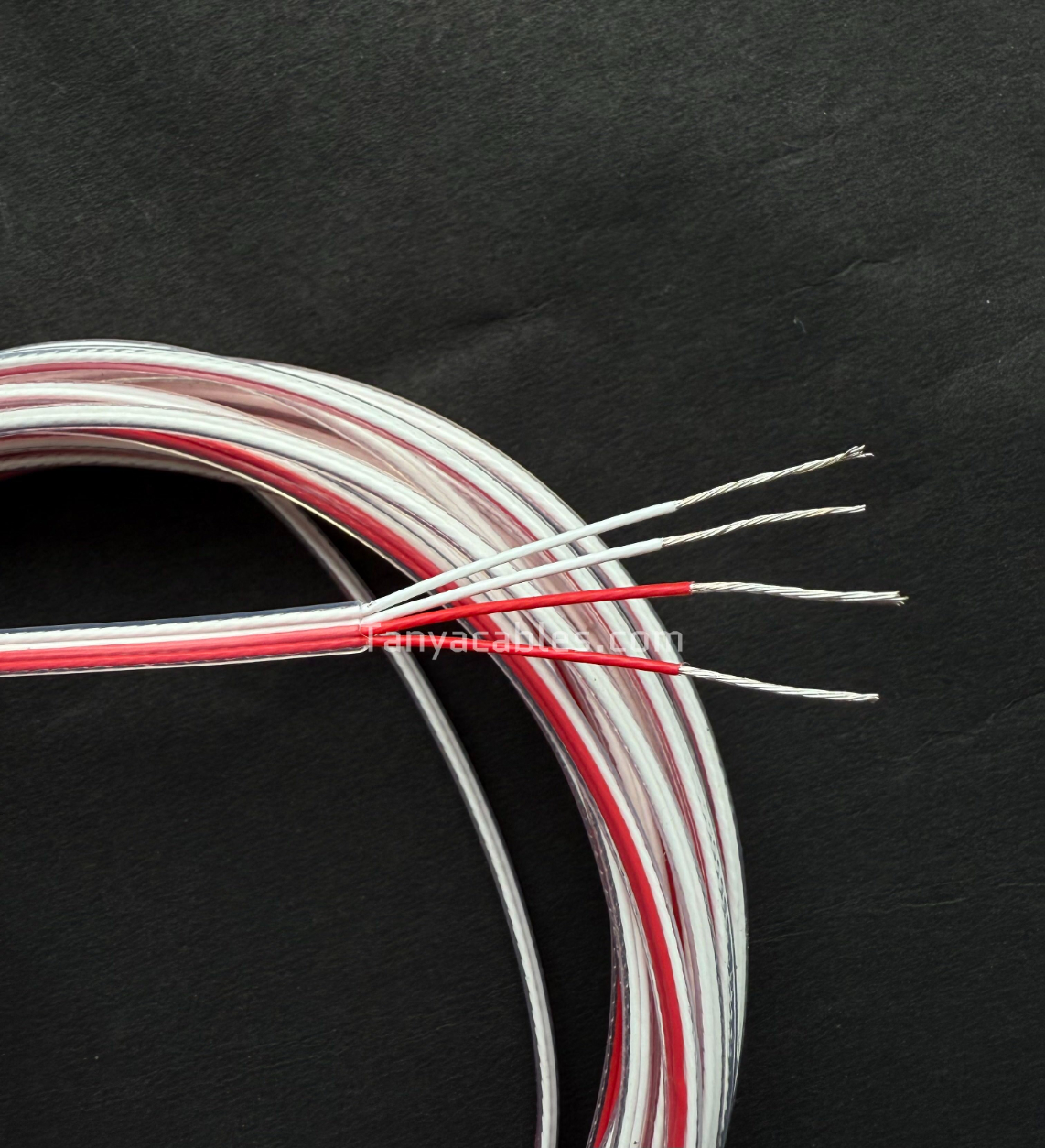
What are FEP RTD cables?
An RTD sensor, such as a Pt100, uses a thin metal element whose resistance changes with temperature. The cable carries that small signal to your controller, display or data logger. If the cable insulation drifts, leaks or ages, the reading drifts with it. FEP insulation holds its electrical properties steady, so the signal reaches the controller reliably, even over long runs, without much distortion. In simple two-wire set-ups, the cable resistance also adds to the reading, which is why the wiring method and cable choice should be planned together. Industrial RTD sensors generally follow the IEC 60751 standard.
Why buyers choose Tanya Enterprises as their FEP RTD cables manufacturer
Our FEP RTD cables are built for jobs where the same accurate reading is needed every single time. We control the insulation thickness with care, and every reel is checked for conductor size, insulation thickness, high-voltage withstand and surface finish before it leaves our unit. The cables are also flexible and tough enough to fit into control panels, instrument racks and tight industrial spaces, which keeps them dependable for years in automation, power generation and process control work.
Customers stay with us because we give a steady product, a fair price and service that shows up on time. Our team helps you pick the right cable before the sale and stays in touch after it.
Supplying and exporting FEP RTD cables
We supply buyers across India and export to overseas customers. For export orders, we pack the cables on rolls or reels so they reach you in good shape, and we can share test reports on request. Tell us your country, cable size, length and quantity, and we will guide you on the best way to ship.
Why use FEP RTD cables:
- Stays thermally stable, so RTD signals stay accurate
- Low dielectric loss keeps signal distortion and measurement drift to a minimum
- Resists chemicals, oils and moisture, so it holds up in harsh
environments
- Keeps its electrical properties steady through repeated heating and cooling cycles
- Flexible build makes routing through panels, trays and instrument setups easy
- Good balance of performance, flexibility and cost
Where FEP RTD cables are used:
- Industrial process control and automation systems
- Power generation and energy facilities
- Chemical and pharmaceutical plants
- Laboratories and testing equipment
- Instrumentation panels and control cabinets
How to choose the right FEP RTD cable:
- Check the highest and lowest temperature the cable will face in real use
- Match the conductor size to your sensor, your cable length and the instrument you use
- List what the cable may touch: oils, moisture, cleaning agents or process chemicals
- Think about movement. A fixed cable and a cable that keeps bending need different care, as shown in the bending radius below
- Tell us the length you need and if your site has electrical noise, so we can suggest the right build
- Choose the colour coding and packing (rolls or reels) that suit your line
Certificates
Technical specifications
HAR
HAR certificate No. CA01.00764
Rated voltage
450/750 VAC
Oil resistance
EN 50363-2-1
Short-circuit temperature
200°C
Rated temperature
-50 ÷ 90°C (@ fixed installation), -30 ÷ 90°C ( in dynamic installations )
Minimum bending radius
8D free movement, 6D @ fixed installation
Technical sheet
download
Available types of packaging
Frequently Asked Questions
What are FEP RTD cables?
FEP RTD cables carry the signal from a resistance temperature detector (RTD) sensor to a controller or display. Their FEP fluoropolymer insulation resists heat, chemicals and moisture while keeping the signal accurate and steady.
Why is FEP insulation good for RTD cables?
FEP has low dielectric loss and strong thermal stability, so it keeps signal drift and distortion to a minimum, even when the cable faces heat swings or exposure to harsh chemicals.
Who is a reliable FEP RTD cables manufacturer in India?
Tanya Enterprises, based in Meerut, Uttar Pradesh, manufactures FEP RTD cables. Our cables are tested before dispatch, can be made to custom specifications, and come with RoHS, REACH, HAR, CE, AD8 and Halogen-Free certifications.
Do you supply and export FEP RTD cables outside India?
Yes. We supply customers in India and export to overseas buyers. We pack the cables on rolls or reels for safe transport and can share test reports on request. Send us your country, size and quantity to get a quote.
What temperature range can FEP RTD cables handle?
Our FEP RTD cables work between -50°C and 90°C in fixed installations, and -30°C to 90°C where the cable moves during use, with short-circuit temperatures up to 200°C. FEP as a material can work continuously up to about 200°C, but the final rating depends on the cable construction, so please check the technical specifications above or ask for the datasheet.
Where are FEP RTD cables commonly used?
They're used in industrial process control and automation, power generation, chemical and pharmaceutical plants, laboratories, and instrumentation panels where accurate temperature readings matter.
Does the RTD cable affect measurement accuracy?
It can if the cable is poor. An RTD signal is very small, so unstable insulation or a bad connection can add drift or noise. FEP insulation helps keep the signal steady, but accuracy also depends on the sensor, the instrument and the wiring method. If your site is long or electrically noisy, tell us and we will suggest the right build.
Can I order FEP RTD cables in custom specifications?
Yes. Tanya Enterprises can adjust conductor size, insulation thickness, cable length and colour coding to match your project. Share your requirement and our team will help you get it right.
Do your FEP RTD cables come with certifications?
Yes. Our FEP RTD cables are certified under RoHS, REACH, HAR, CE, AD8 and Halogen-Free standards, meeting both Indian and international safety and quality requirements.
How can I get a quote for FEP RTD cables?
Fill the enquiry form on this page, email info@fepwires.com or call +91 9045024844. Tell us the conductor size, insulation thickness, length and quantity you need, and our team will reply with a quote.
About the author
Written by the Tanya Enterprises Technical Team, Meerut, Uttar Pradesh. Our team works every day on FEP, PFA and ETFE insulated wires and cables for industrial, thermal and instrumentation use, and answers customer questions on material choice, sizing and testing. You can also read about our FEP insulated heating wires.