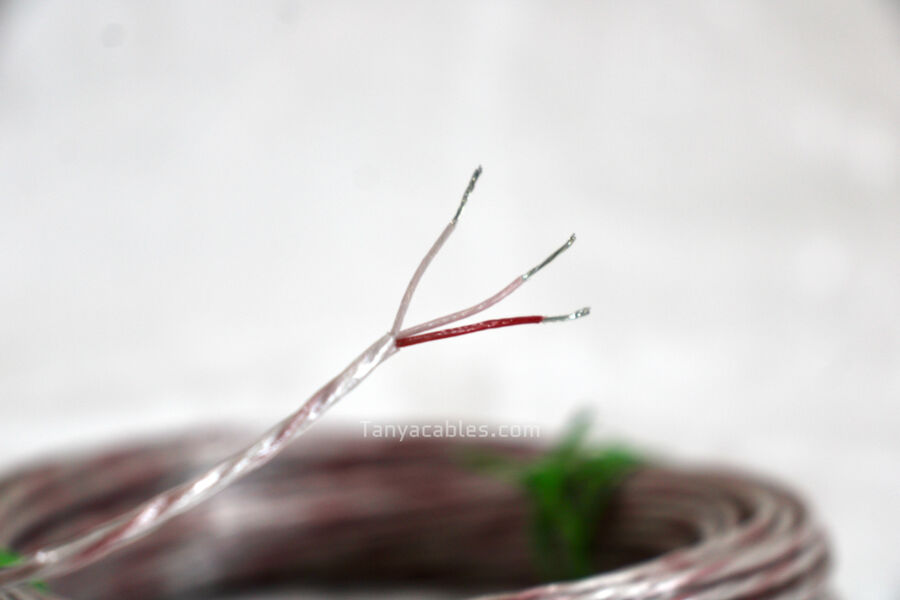
Why PFA is used for RTD cables
An RTD such as a Pt100 reports temperature through a very small change in resistance. The cable must carry that change without adding noise or drifting. PFA is a fluoropolymer that stays electrically stable across a wide temperature span, resists most chemicals and does not soak up moisture. That is why it appears in chemical plants, semiconductor tools, pharmaceutical production and cryogenic test setups. If you want the product basics first, our PFA RTD cables page covers them.
Check the rating of the finished cable, not just the material
PFA as a material works from about -200°C to +260°C. A finished cable, though, is rated by its whole construction: conductor, insulation, any outer layer and how it is built. These ratings are often lower than the material figure, and they can differ between fixed and moving installations.
So ask every manufacturer one direct question: "What is the rated temperature of this exact cable, and is it for fixed or flexing use?" A clear answer, backed by a datasheet, is a good sign. A vague answer is not.
Decide the wire configuration first
RTD cables come in 2-wire, 3-wire and 4-wire forms. The choice depends on your instrument and how far the sensor sits from it.
| Configuration | What it means in practice |
|---|
| 2-wire | Simplest and cheapest, but cable resistance gets added to the reading. Fine for short runs. |
| 3-wire | Lets the instrument compensate for lead resistance. A common choice for industrial use. |
| 4-wire | Removes lead resistance from the measurement almost entirely. Used where accuracy matters most. |
Confirm what your transmitter or controller supports before you order. The cable has to match it.
PFA, FEP or something else?
PFA is usually chosen for higher temperatures, very low temperatures and ultra-clean surroundings. For milder jobs, FEP RTD cables often do the work at a lower cost. If the sensing is done with thermocouples rather than RTDs, you will need FEP thermocouple extension cable instead. And if you simply need PFA wire for general hook-up, see our PFA insulated wires. Our guide on FEP vs PFA vs PTFE compares the materials side by side.
What to look for in a manufacturer
- Documents you can verify. If your project needs RoHS, REACH, CE, HAR, AD8 or Halogen-Free compliance, ask for the certificates. Our PFA RTD cables carry these approvals.
- Customisation. Conductor size, insulation thickness, cable length and colour coding should be adjustable to your sensor and layout.
- Testing before dispatch. Ask whether each cable is tested and whether test reports are available.
- Consistency between batches. Sensors are calibrated to a standard. Cable that varies from lot to lot makes troubleshooting harder.
- Export and packing support. If you are outside India, ask how the cable is wound and packed for sea or air freight.
- Willingness to discuss your application. A good supplier asks about temperature, distance and surroundings before suggesting a cable.
What to send with your enquiry
- Sensor type, for example Pt100
- Number of wires (2, 3 or 4)
- Conductor size and cable length
- Quantity required
- Highest and lowest temperature the cable will see
- Surroundings: chemicals, cleanroom, outdoor, moving parts
If some details are not yet fixed, share the application and we can suggest a suitable construction. For wider cable options, browse our electrical cables range.
About Tanya Enterprises
We are a wire and cable manufacturer based at Vedvyaspuri Industrial Area, Meerut, Uttar Pradesh. We make PFA RTD cables on a made-to-specification basis, test them before dispatch, and supply buyers across India as well as overseas.
Frequently Asked Questions
What should I tell a PFA RTD cable manufacturer when I ask for a quote?
Share the sensor type (for example Pt100), number of wires, conductor size, cable length, quantity, the highest and lowest temperature the cable will see, and the surroundings such as chemicals, cleanroom or outdoor use.
Is the temperature rating of PFA the same as the rating of the finished cable?
Not always. PFA as a material works from about -200°C to +260°C, but a finished cable is rated for what its full construction can handle. Ask the manufacturer for the rating of the finished cable, not only the material.
Should I choose a 2-wire, 3-wire or 4-wire RTD cable?
A 2-wire cable is simplest but includes lead resistance in the reading. 3-wire and 4-wire cables allow the instrument to compensate for it, so they are preferred for longer runs or higher accuracy. Match the cable to what your instrument supports.
Does Tanya Enterprises export PFA RTD cables?
Yes. Tanya Enterprises supplies buyers across India and also exports. Cable is wound on reels or rolls for sea or air freight, and test reports can be provided on request.
Final thought
The right PFA RTD cable is the one that fits your sensor, your instrument and your conditions. Compare manufacturers on the finished-cable rating, wire configuration, documents and willingness to discuss your application. That tells you more than price alone. If you would like help, send your requirement through the form below.