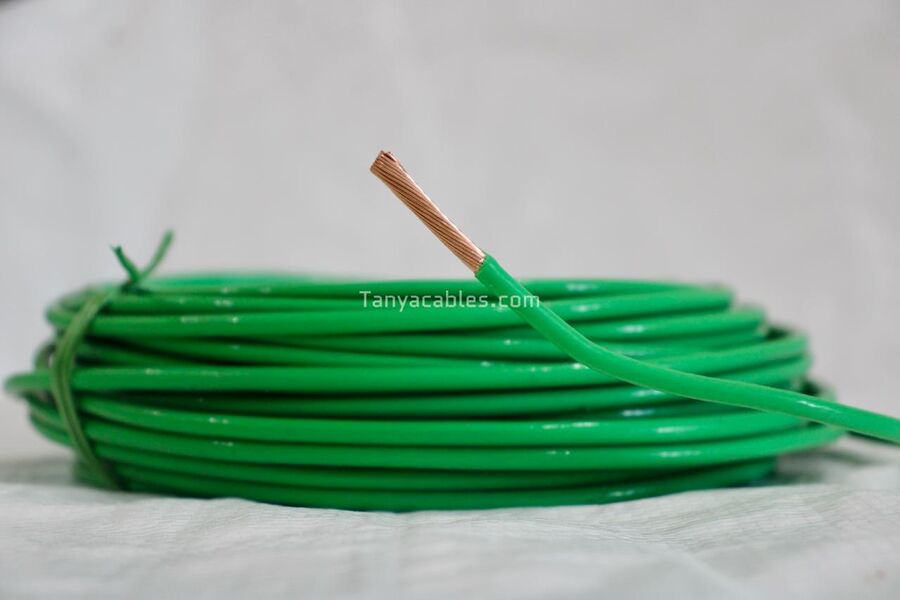
What is FEP wire?
FEP stands for Fluorinated Ethylene Propylene, a fluoropolymer from the same chemical family as PTFE, but with one practical advantage: it's melt-processible. That means it can be extruded onto a conductor the same way ordinary thermoplastics are, which gives FEP wire a smooth, consistent wall thickness and tight dimensional tolerances at a lower manufacturing cost than PTFE. Our FEP insulated wires use this same extrusion process to hold precise tolerances across every batch.
How FEP wire is manufactured
The conductor - typically bare or tinned copper - is drawn to size and then passed through an extrusion line where molten FEP resin is applied as a continuous jacket under controlled temperature and pressure. Because FEP melts and flows like a standard thermoplastic, the extrusion head can hold tight concentricity and wall-thickness tolerances across the full length of the run, something that's much harder to achieve with paste-extruded fluoropolymers like PTFE. After extrusion, the wire is cooled, tested for dielectric strength and dimensional accuracy, and spooled. At Tanya Enterprises, every batch goes through this quality check before it ships, which is why the insulation performs consistently from the first metre to the last.
Key properties of FEP wire
- Handles sustained industrial heat without softening, cracking or losing insulating value
- Resists oils, moisture and most industrial chemicals without swelling or breaking down
- Strong dielectric strength for stable, low-loss electrical performance
- Stays flexible across a wide temperature range, making routing and installation easier
- Naturally flame-retardant and self-extinguishing
- Holds colour coding and surface finish over years of service, unlike PVC which yellows and hardens
Where FEP wire is used
- Electronics and communication equipment - where signal integrity and heat resistance both matter
- Industrial automation and control panels - compact, high-density wiring that needs to last
- Power generation and switchgear - sustained heat and electrical stress in enclosed panels
- Automotive and EV harnesses - see our automotive harness cables built specifically for this environment
- Laboratory and test instrumentation - stable performance for accurate, repeatable readings
- Aerospace and defence wiring - where UL and MIL compliance is non-negotiable
FEP wire vs PVC wire
PVC costs less up front, but it has a lower temperature ceiling, absorbs oils and solvents over time, and stiffens and cracks with age and UV exposure. FEP wire costs more per metre but avoids the repeat replacement, downtime and field failures that come with PVC in demanding environments - which usually makes it the cheaper option over the life of the equipment. If your application runs hotter still, our extruded Teflon wires push the temperature ceiling further, and where mechanical toughness and low weight matter more than raw heat resistance, our ETFE insulated wires are worth comparing. For a full side-by-side, see our guide on FEP vs PFA vs PTFE wire insulation.
Why choose Tanya Enterprises FEP wires
Tanya Enterprises has supplied FEP insulated wire to OEM wire harness manufacturers for over 25 years. Our LCSO-approved, CE and ISO certified facility produces wire that is UL compliant and MIL standard compliant, and every batch is certified under RoHS, REACH, HAR, CE, AD8 and Halogen-Free standards. We also customise conductor size, insulation thickness, wire length and colour coding to match your drawing rather than asking you to work around a standard catalogue size.
Frequently Asked Questions
What is FEP wire made of?
FEP wire is a conductor, usually copper or tinned copper, insulated with Fluorinated Ethylene Propylene - a melt-processible fluoropolymer from the same family as PTFE, extruded on as a smooth, consistent jacket.
What temperature can FEP wire withstand?
Tanya Enterprises FEP insulated wires are rated from -50°C to 90°C in fixed installations and -30°C to 90°C in dynamic installations, with short-circuit temperatures up to 200°C.
What is the difference between FEP wire and PVC wire?
FEP wire handles far higher temperatures, resists oils, chemicals and moisture that would soften or swell PVC, and holds its electrical properties over a much longer service life. PVC is cheaper but degrades faster in heat, sunlight and chemical exposure.