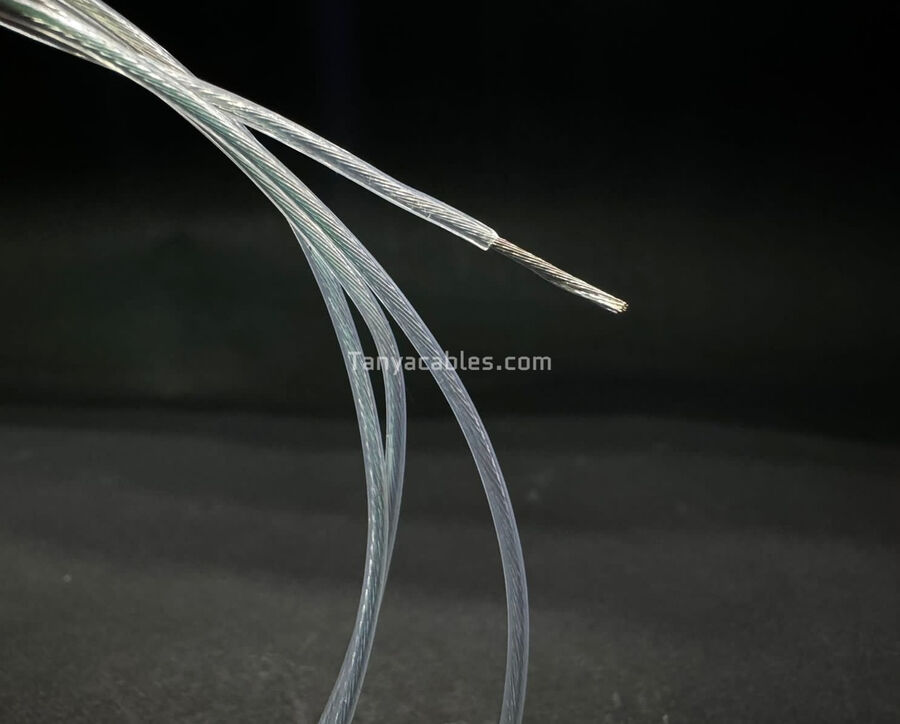
What is FEP insulated heating wire?
FEP insulated heating wire is lead wire or hook-up wire used to connect and route power to resistance heating elements - the coils, strips or elements that generate heat in an oven, appliance or process. Unlike a wire that simply carries current at a steady ambient temperature, heating wire sits close to the heat source itself and cycles through repeated heating and cooling as equipment switches on and off. Our FEP insulated heating wires use the same FEP fluoropolymer insulation as our general-purpose FEP wire, built to handle this cycling without breaking down.
Benefits of FEP insulated heating wire
- Holds up under repeated heat cycling instead of gradually embrittling and cracking
- Keeps dielectric strength stable at elevated temperatures, reducing the risk of arcing or short circuits
- Resists moisture, oils and cleaning chemicals, so performance doesn't degrade in washdown environments
- Stays flexible enough to be wound into coils and tight configurations without stress-cracking
- Long service life reduces the maintenance and downtime that come with frequent heating-wire replacement
Where FEP insulated heating wire is used
- Industrial ovens and furnaces - continuous-duty heating circuits that can't afford insulation failure
- Heat-trace and pipe or vessel heating - long cable runs exposed to sustained external heat
- Appliance heating elements - household and commercial equipment with compact, high-temperature wiring
- Medical sterilization and autoclave equipment - heat cycling combined with strict hygiene requirements
- Packaging and heat-sealing machinery - repeated on/off heating cycles at high frequency
- Aerospace and rail de-icing systems - heating circuits that must perform reliably in harsh conditions
Common failure points in heating wire, and how FEP prevents them
Most heating-wire failures don't happen because the insulation can't handle the peak temperature - they happen because it can't handle the cycling. Every time a heating element switches on and off, the insulation expands and contracts, and over thousands of cycles a lower-grade material starts to develop micro-cracks at bend points or terminations. Those cracks let in moisture, which then leads to insulation resistance breakdown and eventual arcing or short circuits. FEP resists this fatigue far better than PVC or rubber because it keeps its flexibility and mechanical strength across the full cycling range, rather than gradually stiffening with each heat cycle the way lower-grade insulations do.
Specifications to check before you buy
- Rated and short-circuit temperature - confirm the wire's margin above your actual operating temperature
- Voltage rating - matched to the heating circuit's power requirements
- Minimum bend radius - important if the wire will be coiled or wound around an element
- Certifications - look for RoHS, REACH, HAR, CE, AD8 and Halogen-Free compliance for industrial and export use
If your heating system also needs precise temperature feedback, pair your heating wire with our FEP RTD cables or FEP thermocouple extension cable for a closed-loop setup that both heats and monitors reliably. And if you're seeing early failures on your current wiring, our guide on signs your wiring needs high-temperature insulation covers what to look for before the next breakdown.
Frequently Asked Questions
What is the maximum continuous temperature for FEP heating wire?
Tanya Enterprises FEP insulated heating wires are built on the same FEP insulation rated from -50°C to 90°C in fixed installations, with short-circuit temperatures up to 200°C, giving heating circuits a stable margin above normal operating temperatures.
Can FEP heating wire be used in wet or washdown environments?
Yes. FEP insulation naturally resists moisture and most cleaning chemicals, which is why it holds up in food processing, medical sterilization and other washdown environments where the wire is repeatedly exposed to water and detergents.
What is the difference between FEP heating wire and standard FEP insulated wire?
Both use the same FEP insulation, but heating wire is engineered and configured specifically as lead or hook-up wire for heating elements and resistance heating circuits, where the insulation sees repeated heat cycling rather than a single steady operating temperature.